How to influence Google Autocomplete to protect your online reputation

- How autocomplete works>>How does Google autocomplete work?
- How to boost your reputation>>How to boost your reputation with Google autocomplete
This post has been modified to reflect new information since its original publication.
If you’ve ever researched something on Google, then you’ve probably had a good laugh at the hilariously inaccurate or inappropriate search suggestions that Google’s autocomplete feature can sometimes generate. However, it’s anything but funny if Google autocomplete suggests the word “scam” or another defamatory term to complete a search phrase for your name or the name of your business—especially if the negative suggestion appears at the top of the list.
Suggestions like this can fuel a cycle of negativity, with unflattering or untrue search predictions leading more people to click on the negative items such queries bring up. This, in turn, reinforces Google’s more salacious search suggestions, making them consistently appear at the top of the autocomplete list.
The result of this process can be negative content appearing whenever someone searches for you, which can significantly damage your online reputation, as well as your bottom line.
Luckily, there are ways you can influence the search suggestions Google autocomplete shows people. The first step is understanding how Google autocomplete works.
How does Google autocomplete work?
While it’s hard to pin down the exact algorithms Google autocomplete uses to generate its suggestions, we do know that it tracks the most popular searches related to the words you’re typing into the search bar. So, the more people search for a certain phrase, the more likely it is for that phrase to show up in an autocomplete list.
Don't let your search results control you! Get your free Reputation Report Card.
For example, let’s say a searcher (let’s call her Maria) types “fishing” in the search bar. Google knows that most people enter “license” after the search term “fishing,” so it brings up “fishing license” as the top suggestion in the autocomplete drop-down list on Maria’s screen.
Google then combines what most people are searching for with what searchers in Maria’s particular geographical region (in this case, the San Francisco Bay Area) and language are looking for when they enter the same words. This information, coupled with what Google knows about Maria’s own search history, results in a list of popular search terms tailored specifically for Maria.
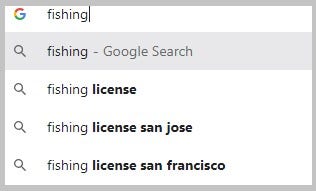
It is this customization feature that makes it difficult to completely control the search terms Google autocomplete suggests when people search for your name. However, there are still things you can do to change which predictions Google chooses.
How to boost your reputation with Google autocomplete
To ensure Google autocomplete associates your name with search terms that show you in the best possible light, you can do two things:
- Report search predictions that violate Google’s autocomplete policies.
- Use reputation management tactics to improve your search results.
Report an autocomplete prediction
Google will remove autocomplete predictions that don’t adhere to its autocomplete policies. So, if an autocomplete list for a search for your name involves the following, there’s a good chance Google will delete it:
- profanity
- harassment
- unfounded rumors
- sexually explicit language
- violence
- disparaging or hateful language
- language that might expose someone to dangers like identity theft or fraud
Are your search results hurting you online? Find out with our free Reputation Report Card.
If this type of content appears in an autocomplete list for your name, you can get Google to remove it by reporting the suggestion on Google’s Manage Google autocomplete predictions page.
However, it’s important to note that Google reserves the right to ignore a request if it decides a prediction offers context related to educational, artistic, documentary, historical, or scientific content, or content that helps the public better understand and participate in politics, society, culture, and the economy.
If Google won’t remove the offending word or phrase, then your next best option is to use reputation management techniques that can alter the online conversation surrounding your name.
Use reputation management tactics
Reputation management is the process of controlling your search results by suppressing negative content and directing internet traffic to new content that Google (and searchers) will find valuable. Over time, the new content displaces the negatives, pushing the old content off of the first page, beyond which 9 out of 10 searchers never look.
This reordering of your search results leads to more clicks on results that you want people to see and search for. As a result of these changes, Google is more likely to include words or phrases about these sites in autocomplete suggestions for your name.
The steps involved in controlling your search results—as well as how you carry out each step—will vary depending on whether you are managing your personal reputation or that of your business.
Reputation management for individuals

Here are some actions you can take to boost your personal online reputation:
- Google yourself—You can’t adequately address any reputation problems until you know what they are. As such, it’s a good idea to Google yourself to see what appears in your search results. Be sure to include all variations of your name in your searches—for example, “Firstname Lastname,” “Nickname Lastname,” “Firstname Lastname city,” and “Firstname Lastname profession.”
- Get a website and name it yourname**.com**—Google places a lot of value on your own website because it is likely the most authoritative result for people who are searching for you online. As such, your website will rank highly. This means it will get lots of clicks, which will signal to Google autocomplete that your site should sit at the top of the suggested search list for your name.
Don't let your search results control you! Get your free Reputation Report Card.
- Regularly publish content on your website—Google views sites that post new articles, images, or other content on a regular schedule as more authoritative than sites that remain static. So, it’s a good idea to find some type of content you are comfortable creating and then stick to a consistent publishing schedule. This could be once a day, once a week, or once a month. Over time, this content will rise in the rankings for your name and displace unwanted content about you that others have created.
- Differentiate yourself from other people with your name—If you have a common name and don’t have a way to stand out from people with similar names, then your search results will likely contain links to content about other people. This can be disastrous for your reputation if your online doppelganger has a criminal history or is famous for doing something unwise or unethical. One way to show Google that you aren’t these other people is to create a personal brand. You can learn how in 7 ways to build a personal brand with content marketing.
- Be active on your social media accounts—Social media accounts usually rank at the top of the search results for a person’s name because they are popular with searchers looking to find out more about you. Don’t waste this valuable real estate on the results page. Instead, engage with others on social media in a way that showcases your character and abilities.
- Ask others to remove content about you—If something online is untrue, outdated, misleading, or likely to harm you in some way, then you can appeal to the person who posted the content (or the website owner that is hosting it) and ask them to take it down or edit it to make it less damaging to you. If the content is on a social platform, you can flag the content for removal if it violates the site’s terms of service.
Reputation management for businesses

Here are some things you can do to boost your business’s online reputation:
- Google your business’s name—Whether you’re a business or an individual, you need to know what reputational threats exist before you can begin to tackle them. Don’t forget to search for alternate spellings of your company name. For example, if you were searching for ReputationDefender, you’d enter the name with and without a space: “ReputationDefender” vs. “Reputation Defender.”
- Publish content on your own website—Assuming you already have a website, you need to start regularly publishing new content on it so that Google sees it as a reliable and authoritative source of information about your business and industry. This will help it rise in the rankings for search terms related to these topics.
- Make a Google Business account—A Google Business profile (formerly Google My Business) ensures that your product or service will appear in Google Maps and at the top of local search results, even if you don’t have a website. You can sign up for a business profile on this Google support page. Once you’ve signed up, be sure to fill out your profile completely to make it easy for customers to find and learn about your business.
Are your search results hurting you online? Find out with our free Reputation Report Card.
- Claim your listing on other business directories and review sites—BBB, CitySearch, Angie (formerly Angie’s List), Yellow Pages, Whitepages, and other business directories can improve traffic to your website and build trust with potential customers. This can boost your website in search engine rankings. Be sure to also claim your profile on review sites like Yelp, so you can project the best possible image to potential customers. An added benefit of claiming your profile on review sites is that you’ll receive notifications whenever someone leaves a review, which means you can respond faster to keep your customers happier.
- Post on your social media accounts—Make sure you’ve filled out your social profiles, especially the main ones like Twitter, Facebook, LinkedIn, and Instagram. Once you’ve done that, you need to engage with customers and leaders in your industry to increase your trustworthiness and authority in the space.
- Respond promptly to reviews—If you receive a negative review, your first step should be to apologize for the customer’s bad experience. After you’ve apologized, you can take the conversation offline and try to work out some agreement that will appease the individual. Often, this kind of response results in the reviewer revising their review to make it less harsh. If the content appears on a social platform, you can also flag the content if it goes against the site’s terms of service. For more information about the best ways to respond to reviews, see Online review management: The complete guide.
Admittedly, reputation management is a time-consuming process, and it can be hard to know what’s working without some trial and error. ReputationDefender offers solutions specifically designed to influence Google autocomplete. We can also help you improve your regular search results at the same time. If you’d like to know more about your options, don’t hesitate to call us for a free consultation.
You can also learn about reputation management in the following articles:
- The definitive guide to online reputation management
- What is online reputation management?
- How to deal with online defamation
- Top 7 online reputation management mistakes businesses need to avoid
Need assistance? Talk to an expert.
All ReputationDefender consultations are free, confidential, and without obligation.
Call 877-492-5209 or Schedule a Consultation